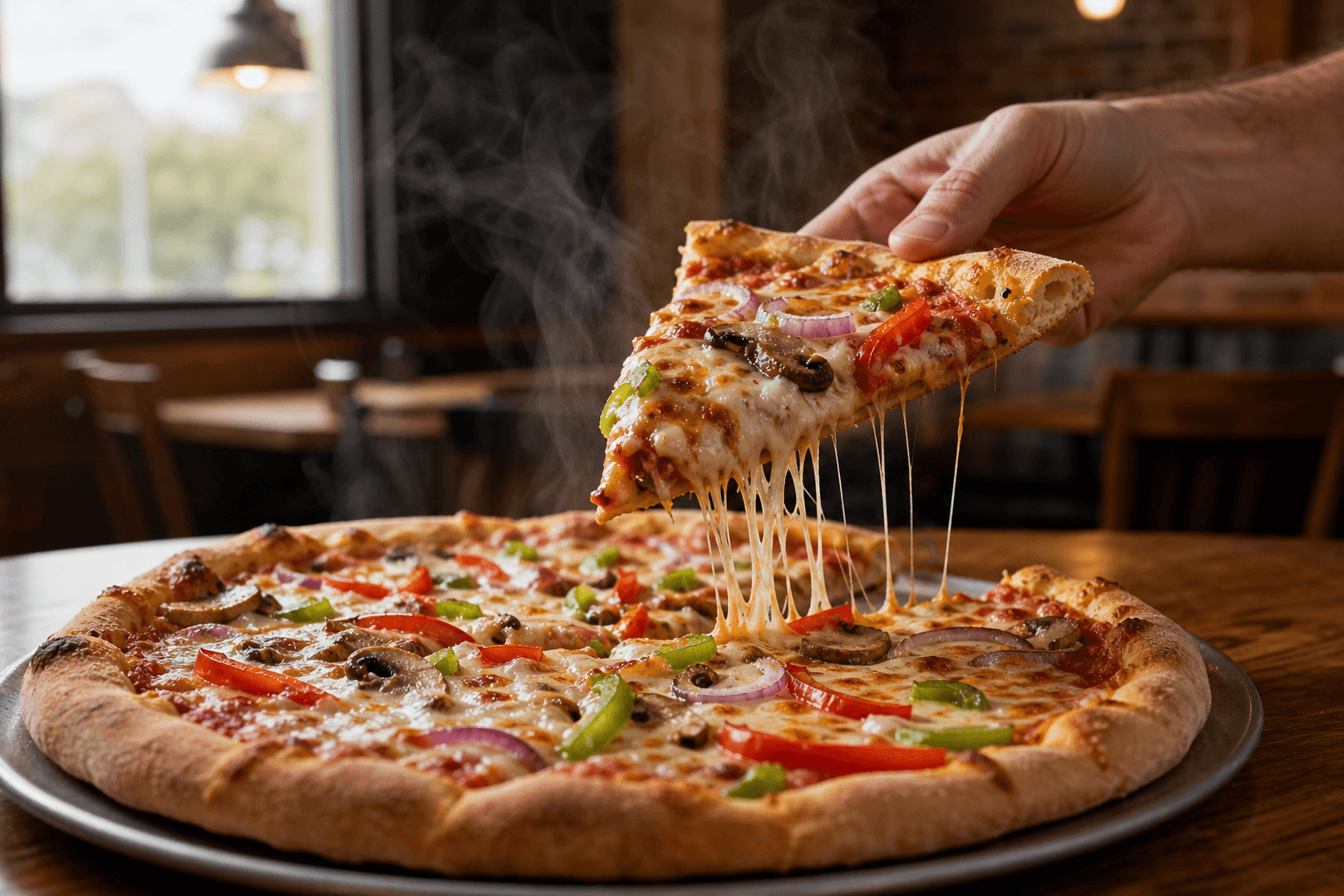
Pizza freshness is mainly about timing and preparation: when the dough, sauce, and toppings are assembled, when the pizza is cooked, and how long it sits before you eat it. A freshly prepared pizza can offer a more lively aroma and better contrast between its crust, sauce, cheese, and toppings, while reheating or storage changes that balance.
Freshness and food safety are related, but they are not the same thing. Freshness describes eating quality, including flavour and texture. Safety depends on handling, time, temperature, and storage. Understanding both helps you choose between dine-in, pickup, delivery, and leftovers with realistic expectations.
What Does Pizza Freshness Actually Mean?
There is no single test that makes a pizza “fresh.” In practical terms, freshness comes from four connected factors: preparation timing, the condition of the ingredients, cooking, and the time between cooking and eating.
A freshly prepared pizza is assembled close to the time it is cooked. That does not mean every slice will have the same texture or that it must be eaten immediately. It means the pizza has not been sitting pre-cooked for an extended period before being served or reheated.
For a closer look at how timing affects flavour and texture, compare the difference between made-to-order pizza and pizza that has already been cooked and held. The useful question is not simply whether a pizza is labelled fresh. Ask what was prepared when, how it was cooked, and how long it travelled before you ate it.
Freshly Prepared vs Reheated vs Leftover Pizza

Each option can be enjoyable, but each creates a different eating experience. This comparison focuses on quality and handling rather than claiming that one option is right for every occasion.
| Option | What happens | Likely quality experience | Practical consideration |
|---|---|---|---|
| Freshly prepared | The pizza is assembled and cooked for the order. | Crust, cheese, sauce, and toppings are at their closest to their original cooked condition. | Best when texture, aroma, and a hot meal are the priority. |
| Pre-cooked or reheated | Pizza has been cooked earlier, held, and possibly warmed again. | Heat may return, but the crust can become drier, softer, or more rigid and toppings may lose some of their original texture. | Convenient, but preparation and holding time matter. |
| Refrigerated leftover | Cooked pizza is chilled and eaten later, cold or reheated. | Cold storage firms the crust and cheese. Reheating can improve warmth, but it cannot always recreate the first-cooked texture. | Quality depends on prompt refrigeration and proper handling. |
“Reheated” is not automatically a negative description. It simply means the pizza has gone through another heating stage. The result depends on the original pizza, the storage conditions, the amount of moisture, and the reheating method.
The Four Factors That Shape Pizza Freshness
1. Dough and crust
The crust is where time and moisture are easiest to notice. A freshly cooked crust can have a contrast between its exterior and interior, but steam trapped inside a closed box can soften a crisp surface. Toppings and sauce also release moisture, which can gradually affect the base.
That is why a pizza may taste different after a short journey, even if it was cooked recently. A thin crust, thick crust, or gluten-free crust can each respond differently to moisture and reheating. Freshness does not promise one specific texture, but shorter holding time usually gives you more of the original cooking experience.
2. Sauce and toppings
Sauce, cheese, vegetables, and meat contribute more than flavour. They also add moisture, weight, aroma, and texture. A well-balanced pizza allows the crust to support the toppings without becoming overwhelmed by them.
Preparation timing matters because toppings are most distinctive when they have not been sitting on a cooked base for an extended period. At a Woodstock pizza restaurant, that may mean choosing from classic combinations, an Indian-fusion option such as Butter Chicken, Tandoori, or Chicken Shawarma, or a custom pizza built around your preferred balance of sauce and toppings.
3. Cooking and the time before eating
Cooking transforms the dough and toppings, but the eating experience continues to change after the pizza leaves the oven. Heat gradually escapes, steam moves through the crust, and cheese and sauce settle as the pizza stands.
A “never pre-cooked” statement describes a preparation practice. It does not mean a pizza can remain at room temperature indefinitely or that it will have the same texture hours later. The oven-to-table interval still matters, whether you eat at the restaurant, collect the order, or receive it at home.
4. Transport, pickup, and delivery
Pickup and delivery are both reasonable choices. Pickup may give you more control over when the pizza leaves the restaurant and when you start eating it. Delivery removes the trip from your evening, but the pizza has to travel before reaching your table.
Neither option guarantees a particular temperature or crust texture. To protect quality, plan to eat the pizza soon after it arrives or after you collect it, and avoid leaving the box open or unattended for long periods. In Woodstock, Noni's offers pickup, delivery, and dine-in, so the best option depends on whether your priority is convenience, control over timing, or eating at the restaurant.
How Noni's Applies the Freshness Idea in Woodstock
Noni's Pizza & Wings describes its pizza as freshly prepared, never pre-cooked, and made to order. The restaurant is located at 300 Main St, Unit 8, Woodstock, and offers pizza for dine-in, pickup, and delivery.
The menu gives diners several ways to explore the idea of freshly prepared pizza. Options include familiar choices such as Hawaiian, Meat Lover, and the Woodstock Special, alongside Indian-fusion pizzas including Butter Chicken, Tandoori, and Chicken Shawarma. Customers can also choose a custom pizza, panzerotti, wings, salads, sides, or ice cream to complete an order.
This local example illustrates an important distinction: a made-to-order approach addresses when the pizza is prepared, while your choice of pickup, delivery, or dine-in affects how soon you eat it. Both parts contribute to the final experience.
Pizza Freshness Is Not the Same as Food Safety
A pizza can seem fresh because it is warm and aromatic, but appearance and smell are not reliable safety tests. Conversely, refrigerated leftovers may no longer taste as fresh as they did from the oven while still being properly handled.
Health Canada identifies the food safety danger zone as between 4°C and 60°C and advises throwing away cooked food left at room temperature for more than two hours. This is a handling rule, not a measure of whether a crust is crisp or whether toppings taste vibrant. Read the current guidance on safe leftover storage when you need to check the difference.
Best-before wording is also about quality, freshness, and related characteristics rather than serving as a universal safety shortcut. The Canadian Food Inspection Agency distinguishes best-before dates from expiry dates, so do not use the look, smell, or taste of food alone to decide whether it is safe.
How to Keep Leftover Pizza Enjoyable and Safe
If you have pizza remaining after pickup, delivery, or dine-in, treat it as cooked food that needs prompt handling. Do not leave it on the counter simply because it still looks or smells fine.
- Refrigerate cooked leftovers promptly rather than leaving them at room temperature for an extended period.
- Keep refrigerated food at 4°C or colder, consistent with Health Canada guidance.
- Discard cooked food that has been left at room temperature for more than two hours.
- Use a covered container or suitable wrapping to limit drying and contact with other foods.
- When reheating, focus on warming the portion thoroughly, understanding that the original crust texture may not return completely.
- Do not rely only on smell, appearance, or taste to judge safety.
Health Canada’s leftover guidance provides general storage information for cooked dishes containing meat and vegetables, including refrigeration at 4°C. The exact quality of leftover pizza will vary with its toppings, crust, packaging, and storage time, so follow current food safety guidance rather than treating a sensory check as proof of safety.
A Practical Pizza Freshness Checklist
Use this checklist when choosing a pizza or assessing it after it arrives. The first points concern quality. The final points concern safe handling.
- Ask about preparation: Is the pizza prepared and cooked for the order, or was it cooked earlier and reheated?
- Consider the crust: Does it have the texture you expected, or has moisture made it unusually soft?
- Look at the toppings: Are the sauce, cheese, and toppings evenly distributed and appealing?
- Think about timing: How long has the pizza been between cooking and eating?
- Choose transport realistically: Pickup may shorten your personal wait, while delivery may be more convenient.
- Check storage: If you are saving slices, refrigerate them promptly.
- Ask about allergens: If you have an allergy, speak with staff before ordering. Cross-contamination may be possible.
Which Option Fits Your Pizza Night?
Choose freshly prepared pizza when the main goal is the closest possible experience to the cooking process: warm toppings, fresh aroma, and the intended contrast between crust and filling. A made-to-order approach supports that goal, but the time before eating still matters.
Choose pickup when you want control over the trip from restaurant to table. Choose delivery when convenience is more important than minimizing transport time. If you are ordering for a group, delivery may be the practical choice even though the pizza will spend longer in transit.
Choose leftovers when you have stored the pizza promptly and are comfortable with a different texture. Reheating can make a chilled slice warmer and more enjoyable, but it should not be treated as a way to reverse every change caused by cooling and storage.
Frequently Asked Questions About Pizza Freshness
Does freshly prepared pizza always taste better?
Not necessarily. Taste is personal, and preferences vary by crust, toppings, cooking style, and temperature. Fresh preparation generally gives you the most immediate version of the pizza, but some people prefer the firmer texture or concentrated flavour of a chilled or reheated slice.
What is the difference between fresh pizza and reheated pizza?
Fresh pizza is cooked for the current order, while reheated pizza has already been cooked and then warmed again. Reheating can restore heat, but moisture movement and the second cooking stage can change the crust, cheese, and toppings.
Is pizza freshness the same as pizza safety?
No. Freshness concerns quality, such as flavour, aroma, and texture. Safety concerns time, temperature, storage, and handling, and food can look fresh without being safe to eat.
How long can cooked pizza stay at room temperature?
Health Canada advises discarding cooked food left at room temperature for more than two hours. Do not extend that period based only on how the pizza looks or smells.
Should leftover pizza be refrigerated?
Yes. Refrigerate cooked leftovers promptly and keep the refrigerator at 4°C or colder. Prompt chilling helps with safe handling, although it will not preserve exactly the same texture as freshly cooked pizza.
Does pickup keep pizza fresher than delivery?
Pickup can reduce the time between leaving the restaurant and reaching your table, but it is not automatically fresher. Your travel time and when you begin eating also matter. Delivery may be the better choice when convenience is the priority.
What does “never pre-cooked” mean for pizza?
It means the pizza is described as being prepared for the order rather than cooked in advance and held for later service. It does not mean the pizza is exempt from normal time and temperature considerations after cooking.
Conclusion: Choose Freshness Based on Your Priority
Pizza freshness is best understood as a combination of preparation timing, cooking, transport, and storage. Freshly prepared pizza is usually the most direct way to experience the intended crust, sauce, cheese, and toppings, while pickup, delivery, and leftovers involve different convenience and timing tradeoffs.
For a Woodstock pizza order, decide what matters most: the shortest route from oven to table, the convenience of delivery, or the value of saving extra slices. Whatever you choose, separate quality checks from safety checks, refrigerate leftovers promptly, and follow current Canadian food safety guidance.
For freshly prepared pizza, wings, panzerotti, Indian-fusion flavours, pickup, delivery, or dine-in in Woodstock, visit Noni's Pizza & Wings.
Topics & Tags: