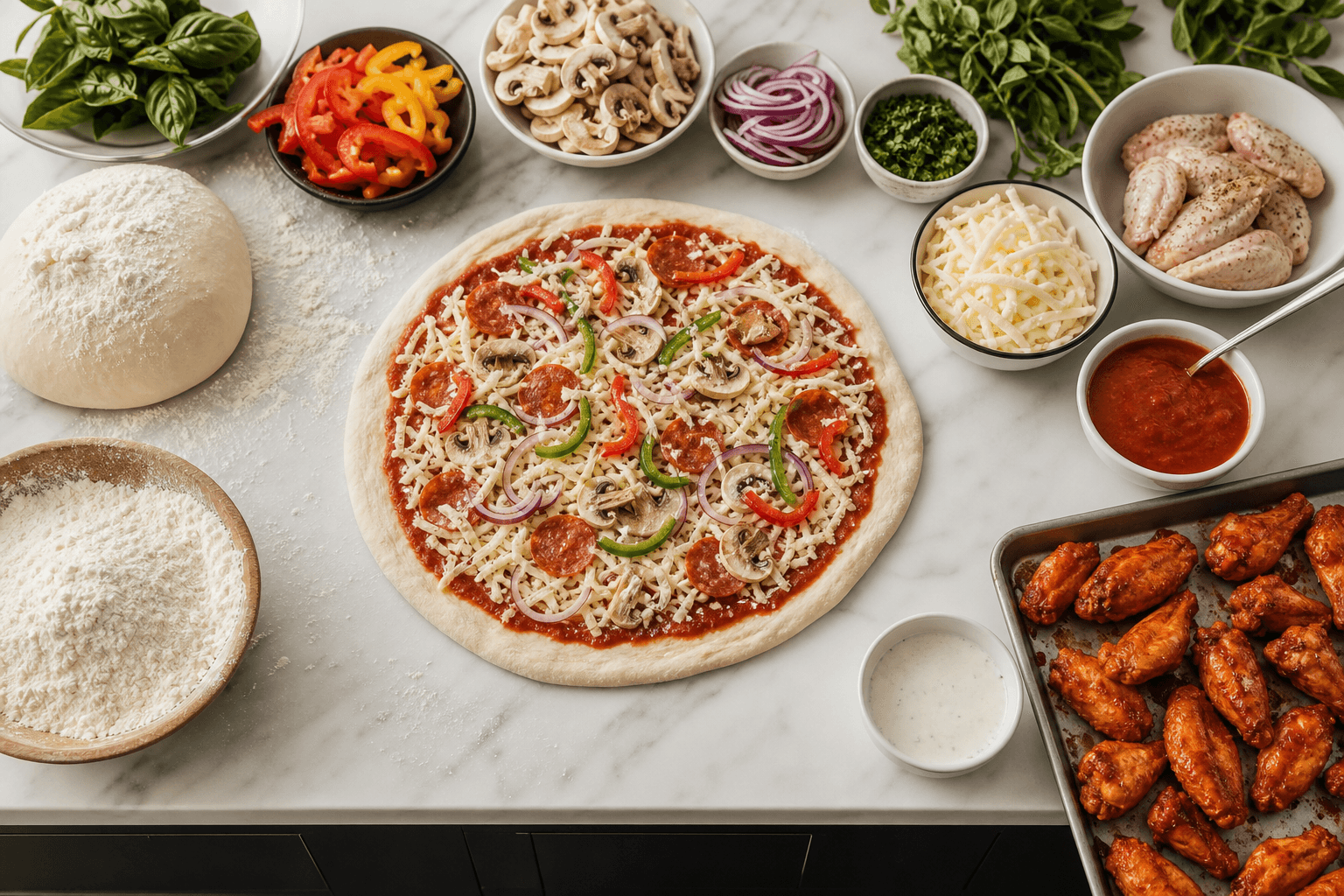
Local ingredient sourcing means buying food produced, harvested, or made within a defined geographic area. In Ontario, local food can include food produced or harvested anywhere in Ontario, but Ontario-wide sourcing is not the same as buying from Woodstock or nearby farms. For pizza and wings, the practical choice is usually a mix of local, regional, national, and global suppliers based on quality, seasonality, price, volume, and reliability. Related reading: Build Your Own Pizza Tips: How to Choose Toppings Without Overloading Your Pie.
That distinction matters for diners and restaurant operators. A restaurant can be locally owned without every ingredient being local, and a freshly prepared pizza does not automatically contain locally sourced ingredients.
What ingredient sourcing, local food, and sustainable sourcing mean
Ingredient sourcing is the process of deciding what food a kitchen buys, where it comes from, who supplies it, how often it arrives, and whether it meets the restaurant's quality, safety, price, and volume requirements.
Local food has more than one everyday meaning, so the geographic boundary should be stated. Ontario's Local Food Act defines local food as food produced or harvested in Ontario, including food and beverages made in Ontario when they contain ingredients produced or harvested in Ontario. That legal definition is broader than “grown near Woodstock.” Ontario's Local Food Act
Sustainable sourcing is a broader assessment than distance. It can include farming or production practices, packaging, waste, labour considerations, delivery efficiency, durability of supply, and the way an ingredient is used. A nearby product is not automatically the most sustainable option, just as a product from farther away is not automatically the least sustainable.
Ontario's 2026 local food report describes sourcing as a balance among proximity, quality, seasonality, availability, and the volume a buyer needs. That is a useful standard for pizza kitchens because they need dependable quantities every week, not just occasional access to an appealing product. Ontario's 2026 local food report
What “local” should mean for a Woodstock pizza restaurant
A restaurant can make local-sourcing language easier to understand by choosing a geographic level and naming it. For a Woodstock business, three practical levels are useful:
- Woodstock-area sourcing: The ingredient comes from Woodstock or a clearly stated nearby area. This is the narrowest and most specific claim.
- Southwestern Ontario sourcing: The ingredient comes from a broader regional supply area. This can suit farms, processors, distributors, and specialty producers serving several communities.
- Ontario sourcing: The ingredient is produced, harvested, or made in Ontario, within the province's legal definition where applicable. It should not be described as Woodstock-grown unless that narrower claim is verified.
“Local” should therefore be treated as a claim with a boundary, not as a general mood. A clear menu note might say “Ontario-grown tomatoes when available” or “cheese made in Ontario,” provided the restaurant can substantiate the wording and explain the seasonal or supply limitation.
Which pizza and wing ingredients can realistically be sourced locally?

Not every pizza ingredient has the same sourcing potential. Fresh vegetables may have a seasonal local option, while spices, specialty sauces, cooking oils, and some processed ingredients may require a much wider supply chain.
| Ingredient category | Local potential | Practical constraints |
|---|---|---|
| Flour | Ontario wheat or flour can come from regional mills or distributors. | Pizza dough needs dependable protein, grind, performance, and volume. A local mill still needs to meet the kitchen's specification every week. |
| Cheese | Ontario-made mozzarella or other cheeses can be sourced regionally. | Melting behaviour, moisture, shred format, case size, price, and delivery frequency affect whether a cheese works on a busy pizza line. |
| Tomatoes | Fresh Ontario tomatoes may suit seasonal toppings, salads, or specials. Processed tomato products may also have an Ontario-made option. | Pizza sauce requires consistent flavour, acidity, texture, and year-round volume. Fresh local tomatoes are seasonal and may need processing or preservation. |
| Meat toppings | Ontario pork, beef, or processed meats can come from local or regional suppliers. | Restaurants need consistent cuts, curing, portioning, packaging, food-safety documentation, and reliable case quantities. |
| Poultry and wings | Ontario poultry can be sourced through regional distributors. | Wing size, trim, frozen or fresh format, delivery temperature, case quantities, and price all affect menu consistency. |
| Vegetables | Onions, peppers, mushrooms, leafy greens, and seasonal produce may have local or Ontario options. | Harvest seasons, weather, washing, trimming, storage life, and weekly availability can change quickly. Some vegetables remain practical through a distributor instead of direct farm delivery. |
| Herbs | Fresh herbs can be locally available during the growing season. | Short shelf life, small order volumes, and storage requirements can make local herbs difficult to use consistently all year. |
| Sauces | A local producer may make hot sauce, barbecue sauce, or another specialty sauce. | Recipe consistency, allergen information, packaging, shelf life, minimum orders, and compatibility with the menu need to be checked. |
| Spices | Blended or packaged spices may be made in Ontario, even when the raw spices originate elsewhere. | “Made in Ontario” does not necessarily mean every ingredient was grown in Ontario. The claim needs to identify what is actually local. |
| Cooking oils | Some Ontario-produced oils may be available. | Frying and baking require a suitable smoke point, neutral flavour, stable supply, and a price that works at the required volume. |
The key question is not “Can this ingredient be found locally once?” It is “Can this ingredient meet the restaurant's specification, volume, storage, delivery, and cost requirements throughout the period it appears on the menu?”
Local, regional, or global: choosing the right supply level
A strong sourcing plan does not treat local purchasing as automatically superior in every category. It compares the available options against the restaurant's actual needs.
| Factor | Local | Regional or Ontario-wide | Broader supply chain |
|---|---|---|---|
| Cost | May be competitive for seasonal products, but smaller volumes and direct delivery can raise the unit cost. | Often balances volume, distribution, and Ontario origin. | May offer strong pricing, large case sizes, or established contracts. |
| Consistency | Can vary with harvests, production capacity, and weather. | May provide more reliable specifications through processors or distributors. | Often designed for standardized year-round supply. |
| Freshness | Shorter distance can help, but harvest timing, storage, and delivery still matter. | Can provide a practical balance between freshness and dependable logistics. | May involve longer transport or storage, but established cold-chain systems can still protect quality. |
| Availability | Usually more seasonal and limited by producer capacity. | Broader pool of suppliers can reduce gaps. | Typically offers the widest year-round selection. |
| Resilience | A direct relationship can be valuable, but relying on one small supplier creates a single point of failure. | Multiple distributors or producers can create useful backup options. | Large networks may offer alternatives, though they can be exposed to wider disruptions. |
| Environmental considerations | Shorter transport may help in some cases, but production method, packaging, refrigeration, and waste also matter. | Efficient consolidation can sometimes reduce trips and waste. | Scale and efficient logistics may offset some distance, while storage and transport impacts vary. |
Use a simple decision rule: choose a local option when it meets the required quality, safety, volume, delivery, and cost conditions. Choose a regional or broader supplier when that is the more reliable way to protect the menu, reduce waste, or maintain a consistent product. A mixed supply chain is often more realistic than an all-local promise.
The question about the “top five ingredients to avoid” does not have a universal answer for this topic. Ingredients are not automatically unsuitable because they are local, imported, fresh, processed, or packaged. The relevant checks are the restaurant's recipe, allergens, food-safety controls, supplier documentation, and the diner's own dietary needs.
A supplier-vetting framework for a small pizza kitchen

A supplier should be evaluated as a business partner, not just as a source of an attractive ingredient. Ontario's local-food guidance recommends origin audits, supplier research, purchasing goals, tracking, staff training, and clearer identification of local items. Ontario's local food recommendations
1. Define the ingredient requirement
Write down the exact product needed: for example, shredded mozzarella with a specific moisture and melt performance, or wings within a preferred size range. Add the weekly quantity, delivery days, storage space, preparation format, and acceptable price.
2. Request origin information
Ask where the ingredient was grown, raised, processed, packed, and distributed. “Made in Ontario” may describe processing rather than the origin of every raw material, so the claim should match the wording the supplier can document.
3. Check food-safety and product documentation
Request the documentation appropriate to the product and supplier, including product specifications, allergen information, handling instructions, lot or traceability information, and applicable food-safety documentation. A local supplier still needs to meet the restaurant's safety and quality requirements.
4. Calculate the delivered cost
Compare the invoice price with delivery fees, minimum orders, trimming loss, packaging, storage, labour, and spoilage. A cheaper case is not cheaper if the kitchen discards a large portion or cannot use it before its quality declines.
5. Test consistency before changing the menu
Run a controlled trial. Measure dough performance, bake colour, cheese melt, topping yield, wing cook time, sauce adhesion, holding quality, and customer response. Test more than one delivery if the ingredient will become a regular menu component.
6. Confirm logistics and a backup plan
Ask about order cut-off times, delivery windows, substitutions, shortages, weather disruptions, minimum order quantities, and storage requirements. Keep a qualified backup supplier for core ingredients such as flour, cheese, poultry, and sauce components.
A small restaurant can score each supplier from one to five on the following criteria:
- Origin proof and clarity of the local claim
- Food-safety and product documentation
- Quality and performance in the recipe
- Consistency across deliveries
- Delivered cost and minimum order fit
- Availability across the required season
- Delivery reliability and communication
- Storage life and waste risk
- Backup supply and disruption resilience
Do not let a high origin score conceal a failing safety, consistency, or logistics score. The best supplier is the one that supports the complete menu requirement.
How sourcing choices can shape a pizza and wings menu
Local sourcing does not require changing every recipe. A restaurant can keep dependable core ingredients while using verified seasonal products in clearly identified specials, sides, salads, or toppings.
Hypothetical example: If Ontario peppers are available in a suitable quantity during part of the growing season, a restaurant could offer a limited-time roasted-pepper pizza or add them to a seasonal salad. The menu should state the geographic scope and availability period, then remove or rename the item when the supply ends.
Another hypothetical example: A regional producer's sauce could become a limited-time wing flavour after the kitchen tests its heat level, texture, allergen information, case size, and shelf life. The restaurant could name the sauce and its origin if that information is verified, without claiming that all wing sauces are local.
Seasonal sourcing can also influence purchasing discipline. A rotating feature lets the kitchen buy within a realistic availability window, while the core menu remains stable for customers who want a familiar pizza or wing order. This approach reduces the pressure to promise year-round access to a seasonal ingredient.
What this means in Noni's Woodstock context
Noni's Pizza & Wings is a locally owned restaurant in Woodstock, Ontario. Its website describes food as freshly prepared, never pre-cooked, and made to order, and lists classic pizzas, wings, panzerotti, salads, sides, ice cream, and Indian-fusion pizzas.
Those menu categories do not establish the geographic origin of the flour, cheese, tomatoes, poultry, spices, sauces, or other ingredients.
For Woodstock diners, the useful distinction is simple: local ownership describes who operates the restaurant and where it is based; local ingredient sourcing describes where particular ingredients were produced, harvested, processed, or purchased. Noni's local ownership and fresh preparation should not be read as proof of a specific local-supplier relationship or sourcing percentage.
How to communicate a local ingredient claim customers can trust
A trustworthy claim identifies four things: the ingredient, the supplier or supplier type, the geographic scope, and any seasonal or availability limit.
- Specific and supportable: “Ontario-grown tomatoes used in this seasonal salad while available.”
- Specific about processing: “Sauce made in Ontario with ingredients identified by the producer.”
- Clear about scope: “Cheese sourced from an Ontario producer” rather than “all ingredients are local.”
- Transparent about change: “Supplier and availability may vary by season.”
Claims such as “everything is local,” “farm-to-table,” or “sustainable ingredients” need evidence that covers the whole claim. If only one topping is local, name that topping. If a supplier changes, update the menu language instead of allowing an old claim to continue indefinitely.
For another practical perspective on evaluating broad ingredient-quality language, review these questions about premium-quality ingredient claims before treating a phrase such as “premium” or “high quality” as proof of a specific sourcing practice.
Frequently asked questions about local ingredient sourcing
Does local food mean food produced in the same city?
No. Local can mean a city, a nearby area, a broader region, or Ontario as a whole, depending on the definition being used. Ontario's legal definition covers food produced or harvested in Ontario, so a restaurant should state the narrower geographic scope when it means Woodstock-area sourcing.
Is local sourcing always more sustainable for a pizza restaurant?
No. Distance is only one factor. Production methods, packaging, refrigeration, delivery efficiency, food waste, ingredient durability, and supply reliability also affect the overall result. A regional supplier with efficient delivery and low waste may be a better operational choice than a nearby supplier whose product arrives inconsistently or spoils quickly.
How can a customer verify a restaurant's local ingredient claim?
Look for the named ingredient, geographic boundary, supplier or producer, and season or availability condition. A customer can also ask whether “local” refers to where the food was grown, where it was processed, or where it was purchased. Vague language without a scope is difficult to evaluate.
Can every pizza ingredient be sourced locally in Ontario?
No. Some flour, cheese, meats, poultry, vegetables, and sauces may have Ontario options, while spices, specialty ingredients, oils, processed products, or year-round quantities may require a broader supply chain. A realistic menu may combine local or Ontario ingredients with regional, national, or global products.
Does Noni's Pizza & Wings currently claim to use locally sourced ingredients?
The supplied Noni's website information verifies local ownership in Woodstock, fresh preparation, and the restaurant's pizza, wings, panzerotti, salad, side, ice cream, and Indian-fusion menu categories. It does not verify specific local ingredient suppliers, a local-sourcing policy, or a percentage of ingredients sourced locally.
Ontario's Buy Ontario framework concerns public-sector procurement and does not create a general local-sourcing obligation for a private pizza restaurant. Ontario's Buy Ontario framework
Choose food with clearer information
Local ingredient sourcing is most useful when it is specific enough to check. Ask what ingredient is local, what geographic boundary applies, whether the supply is seasonal, and how the restaurant balances origin with quality, consistency, price, waste, and reliability.
To compare local ownership, preparation, menu range, and ordering options in Woodstock without assuming that every ingredient is local, visit Noni's local pizza delivery options.
Topics & Tags: