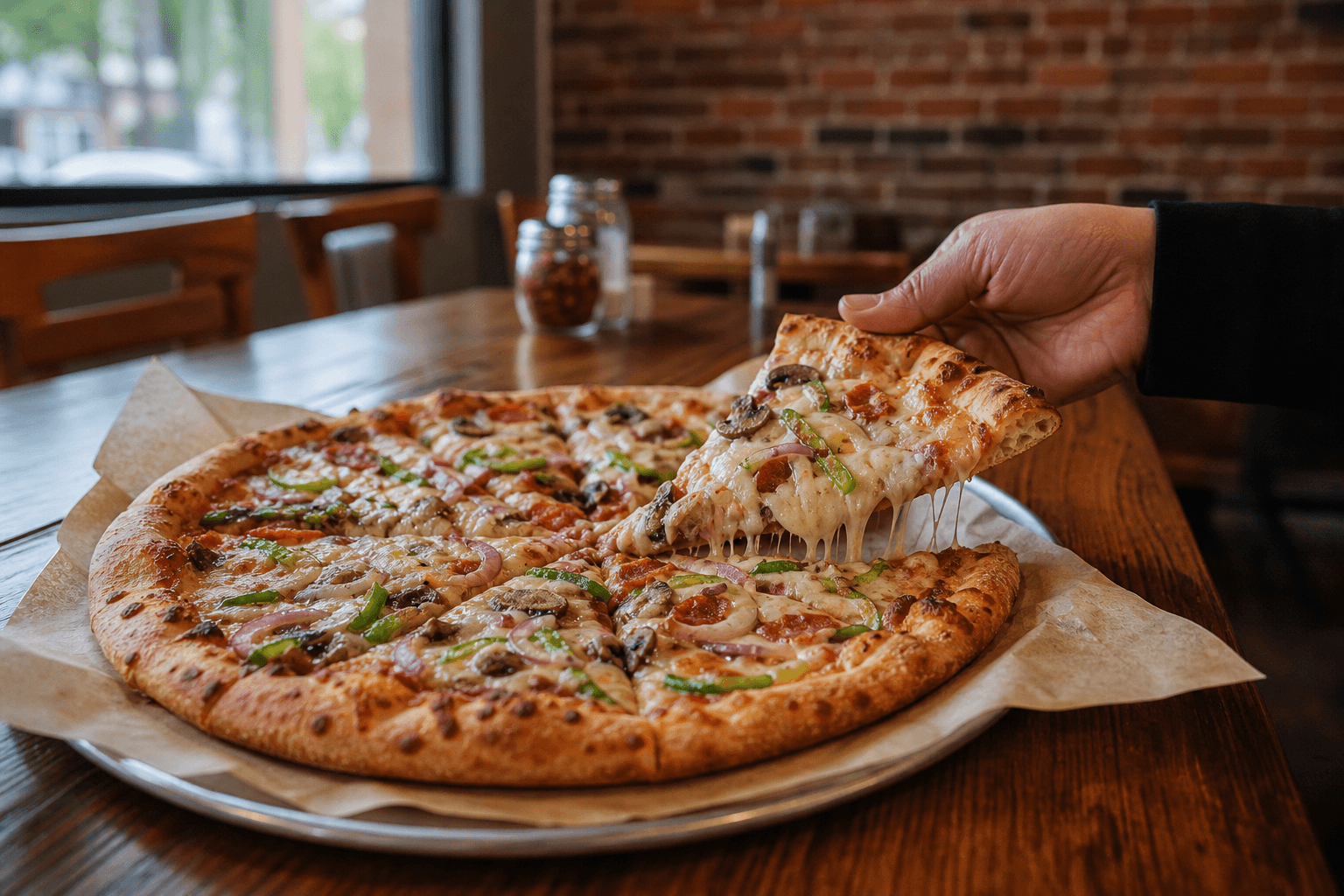
When a pizza menu says “hand-tossed crust,” it usually describes how the dough is shaped rather than one universal thickness or texture. The finished pizza may be soft, chewy, crisp around the edge, or somewhere between, depending on the restaurant’s dough, shaping, toppings, and baking method.
That is why hand-tossed crust should be compared with the restaurant’s other options instead of treated as a standard definition. In Woodstock, the most useful questions are what texture you want, how heavily topped the pizza will be, how hungry you are, and whether you will eat it immediately or after pickup or delivery.
Quick summary

- Hand-tossed usually refers to dough shaping, but it does not guarantee one thickness or edge style.
- “Traditional” and “original” are often house labels, so they may not mean exactly the same thing at every pizzeria.
- Choose based on the bite you prefer, the toppings you plan to order, your appetite, and whether the pizza must travel.
- Before ordering, confirm the crust’s thickness, edge style, topping capacity, and availability for pickup, delivery, or dine-in.
What hand-tossed crust usually means
Hand-tossed crust generally means the dough is shaped by hand rather than produced only as a uniformly pressed or machine-formed base. The phrase can suggest a more individual, shaped edge, but it does not tell you exactly how thick the centre will be or how airy the rim will feel.
It also does not automatically mean that the dough was spun in the air. Restaurants may use “hand-tossed” as a broad description for a hand-shaped crust without making a specific claim about the preparation technique. The term does not, by itself, confirm the ingredients, fermentation time, baking temperature, amount of oil, or final crispness.
For a diner, the practical meaning is simple: treat hand-tossed as a starting point, then ask what the restaurant means by it. If you enjoy a moderate base with some chew and a noticeable edge, it may be worth considering. If you want a very thin, crisp bite or a deep, soft base, ask whether another option is a better match.
Hand-tossed, traditional, and original crust compared

Pizza menus commonly use familiar labels to make ordering quicker. However, “traditional” and “original” are not fixed industry definitions that guarantee the same result everywhere. One restaurant’s traditional crust may be its standard medium-thickness base, while another may use the term for a thinner or more substantial option.
| Menu label | What it may communicate | What it does not guarantee | Useful question |
|---|---|---|---|
| Hand-tossed | A dough that is shaped by hand, often with a distinct edge or varied surface. | A specific thickness, chew, crispness, or airiness. | How thick is the centre, and what is the edge like? |
| Traditional | The restaurant’s familiar or standard pizza base. | That it matches another restaurant’s traditional crust. | Is it thin, medium, or thick compared with your other choices? |
| Original | A house term for a core or classic crust option. | That it is the original recipe, hand-tossed, or a particular thickness. | What texture and thickness does “original” describe here? |
When comparing menu wording, looking at how a restaurant presents its crust choices can help you notice which details are actually provided, such as thickness, edge style, or preparation notes. You can also review crust choices as an example of menu terminology in a pizza-ordering context, while remembering that each restaurant’s labels remain specific to its own menu.
Choose your crust by texture, toppings, and appetite
If you prefer a lighter or crisper bite
Look for wording that clearly indicates thinness or a crisp style rather than assuming hand-tossed will be light. A thinner base can suit diners who want the toppings and sauce to dominate each bite, or who prefer a less substantial crust around a shared meal.
Ask whether the edge is also thin or whether the pizza has a fuller rim. A pizza can have a relatively thin centre and still include a more noticeable crust around the outside.
If you prefer a softer, chewier, or more filling base
Ask about a thicker or standard crust option, and confirm whether the centre remains soft after baking. A more substantial base may be a better fit when the crust is an important part of the meal, when you have a larger appetite, or when you want leftovers to feel satisfying.
Do not rely on “original” or “traditional” alone. Those labels may describe a filling standard option at one restaurant and a lighter base at another.
If you are ordering many toppings
Heavier toppings can change how the pizza feels and holds together. If you are choosing several meats, vegetables, or extra cheese, ask whether the restaurant recommends a particular crust for that topping load. A sturdier base may be easier to handle, while a lighter one may keep the meal from feeling too heavy.
This is a preference decision, not a universal rule. The restaurant’s dough and baking method matter, so ask whether the crust stays firm enough for the toppings you want.
If the pizza is for sharing
For a group, the safest choice is often a crust that sits between the extremes unless everyone has a strong preference. A moderate base can offer enough substance for hungry diners without making the pizza feel overly heavy for those who prefer to focus on the toppings.
If the group has different preferences, consider ordering different crust styles where the menu allows it. Otherwise, confirm the standard option before placing a larger order.
Does pickup, delivery, or dine-in change the best choice?
The eating setting can influence which texture feels best. A pizza eaten immediately in the restaurant may have the texture intended by the kitchen, while a pizza travelling home can soften slightly from heat and steam inside the box.
For delivery or a longer trip home, ask how the crust is expected to arrive and whether a crisper option is likely to suit your preference. If you prefer a softer bite, the travel time may matter less to you. If you care most about a crisp underside or edge, pickup may give you more control over when you eat it.
Pickup also makes it easier to ask a quick question at the counter or confirm the order before leaving. For dine-in, you can usually make your preference clear when ordering and eat the pizza right away. None of these options is automatically better. The decision depends on how strongly you value crispness, convenience, and immediate serving.
What to confirm when ordering from Noni’s in Woodstock
Noni’s Pizza & Wings is a locally owned restaurant in Woodstock serving pizza, wings, panzerotti, salads, sides, and other menu items. Its supplied website information describes the food as freshly prepared, never pre-cooked, and made to order, with ordering available for pickup or delivery in the Woodstock area.
Those details provide useful ordering context, but they do not confirm that Noni’s currently offers a hand-tossed crust. The available evidence also does not establish a specific thickness, edge style, dough method, or texture for a hand-tossed option. Check the current menu or ask the restaurant before assuming that hand-tossed, traditional, or original means a particular thing.
If you are ordering an Indian-fusion pizza such as Butter Chicken, Tandoori Chicken, or Chicken Shawarma, the same principle applies. Ask which crust best suits the toppings and whether the menu uses a specific label for its standard base.
A quick crust-ordering checklist
Before placing your Woodstock pizza order, use these questions to turn a vague crust label into a clear choice:
- What does the label mean here? Ask whether “hand-tossed,” “traditional,” or “original” describes the shaping method, the standard recipe, or simply the restaurant’s name for that crust.
- How thick is the centre? Confirm whether it is thin, medium, or thick, rather than relying on the label alone.
- What is the edge like? Ask whether the rim is flat, raised, soft, chewy, or crisp if that detail matters to you.
- How will it suit my toppings? If you are ordering several toppings, ask whether the restaurant recommends a particular base.
- What texture do I want? Say whether you prefer light and crisp, soft and substantial, or a balanced bite.
- When will I eat it? Mention whether the order is for pickup, delivery, or dine-in if you are especially concerned about texture on arrival.
- Is that option available today? Confirm availability and any size or ordering restrictions before paying.
Frequently asked questions
Is hand-tossed crust the same as thin crust?
No. Hand-tossed generally describes how the dough is shaped, while thin describes the finished thickness. A hand-tossed pizza may be thinner, medium-thickness, or otherwise shaped according to the restaurant’s own method. Ask about thickness directly.
Do traditional crust and original crust mean the same thing?
Not necessarily. Both are often restaurant-specific labels. They may refer to a standard or classic base, but their thickness, edge, and texture can vary. Compare the descriptions or ask the restaurant what each option means.
What should I ask a Woodstock pizza restaurant about its crust?
Ask what the label means, how thick the crust is, what the edge is like, whether it suits your toppings, and whether the option is available for your order type. Those questions are more useful than choosing based on the name alone.
Choose the crust by the result you want
Hand-tossed crust is a useful menu term, but it is not a universal promise about thickness or texture. Traditional and original can be equally dependent on the restaurant, so the best choice comes from matching the description to your preferred bite, topping load, appetite, and eating setting.
For Woodstock orders, confirm the current crust choices before assuming that a familiar label has a familiar meaning. To review local pizza options and place an order for pickup or delivery, visit Noni's Pizza & Wings.
Topics & Tags: