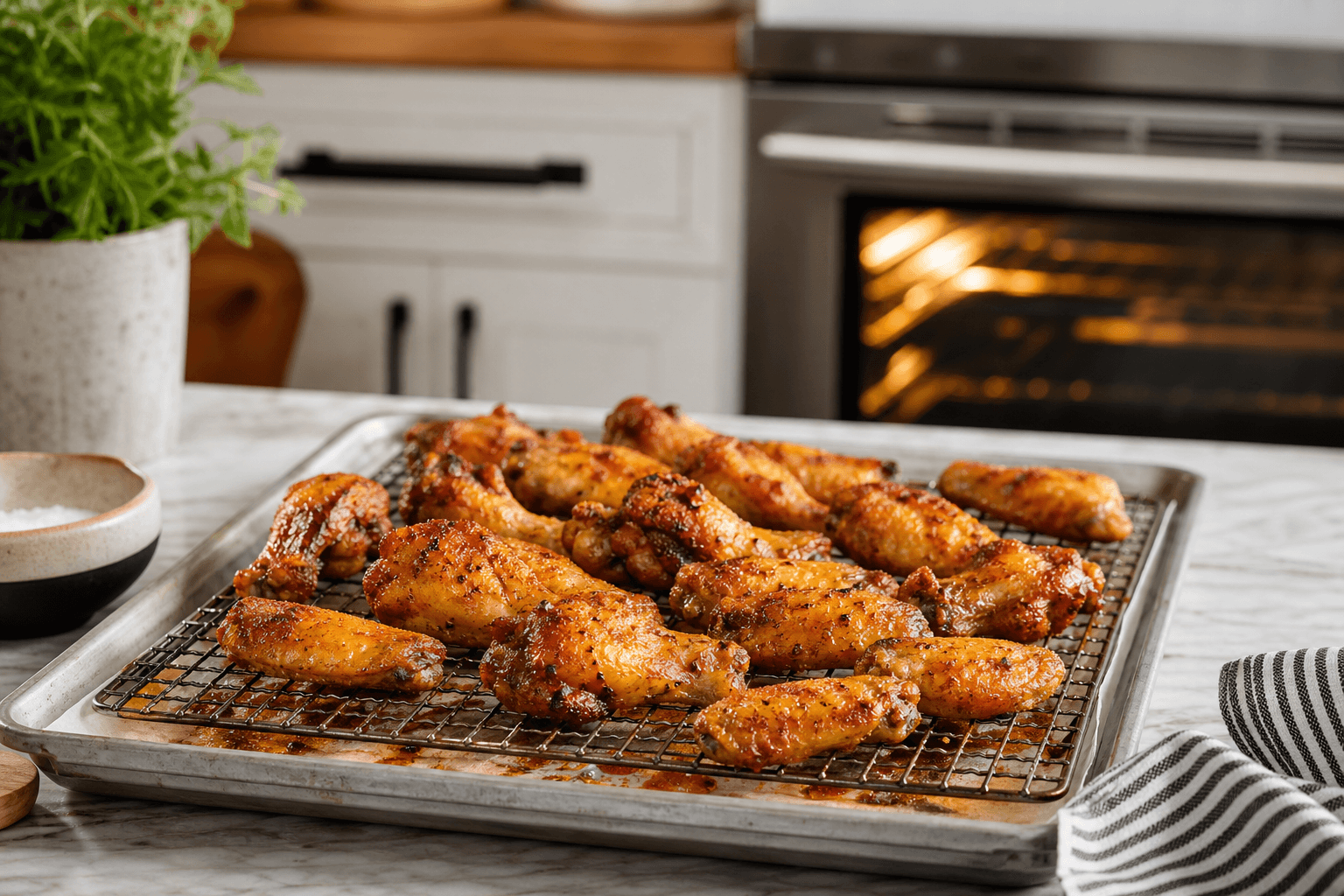
For crisp oven-baked chicken wings, dry the wings thoroughly, arrange them in a single layer with space between pieces, and bake until the thickest part reaches 74°C (165°F). A wire rack improves airflow, sauce usually goes on after baking, and doneness should be judged by temperature rather than time alone.
This guide covers the ingredients, pan setup, preparation, batch size, flavour finishes, troubleshooting, storage, reheating, and when ordering baked wings makes more sense than cooking at home. Related reading: What Do Honey Garlic Wings Taste Like?.
The reliable baked-wing method at a glance
- Thaw frozen wings completely in the refrigerator.
- Pat every surface thoroughly dry.
- Season lightly, with or without an optional coating.
- Arrange wings in one layer with space between pieces.
- Bake at 220°C (425°F) for approximately 35 to 50 minutes.
- Turn the wings or rotate the tray halfway through if browning is uneven.
- Check the thickest pieces with a digital thermometer. Poultry wings should reach 74°C (165°F).
- Rest for two to five minutes, then serve plain or toss with sauce.
Time is only a starting point. Wing size, starting temperature, oven calibration, pan material, rack position, and airflow all affect cooking.
Prepare the wings before they reach the oven
For 1 kg of raw, separated chicken wings, gather 1 tablespoon of neutral oil, 1 teaspoon of salt, and 1 to 2 teaspoons of dry seasoning such as black pepper, paprika, garlic powder, onion powder, or a prepared spice blend. Add more seasoning only if your blend is salt-free, since heavily salted wings can become harsh after sauce is added.
For extra surface texture, use either 1 tablespoon of baking powder or 2 tablespoons of flour per 1 kg of wings. This coating is optional. Toss the dry wings with the oil first, then add the salt and seasoning, followed by the coating if you are using one. The goal is a thin, even film, not a thick batter.
Thaw frozen wings in the refrigerator, not on the counter. Pat the skin dry, including the folds around the joints. Whole wings contain a drumette, flat, and tip. Separate the pieces at the joints for more even cooking and easier serving, and trim loose skin or excess fat without removing all the skin.
Do you need flour or baking powder?
No. Wings can be baked with only oil, salt, and spices. A bare-skin method gives clean flavour and avoids a coating that can soften under sauce. A light coating of flour or baking powder creates a drier, more textured surface, but too much can become pasty where pieces touch.
Keep raw chicken separate from ready-to-eat food. Wash the thermometer and utensils after they contact raw or partially cooked poultry. Insert the thermometer into the thickest part while avoiding bone, as explained in Health Canada’s poultry-safety guidance.
Choose the pan and oven setup that fits your goal
The wings need space whichever setup you choose. Your best option depends on whether crispness, easy cleanup, or speed matters most.
| Setup | Best for | Trade-off |
|---|---|---|
| Wire rack over a lined sheet pan | Maximum airflow and crispness | More washing and possible sticking |
| Directly on a lined sheet pan | Easy cleanup and small batches | The underside sits in rendered fat |
| Convection setting | Faster airflow and browning | Edges may brown quickly |
Use a lightly oiled wire rack for the crispest finish. For a simple weeknight method, use parchment or foil on a sturdy sheet pan and turn the wings partway through. With convection, monitor the wings earlier if your oven browns aggressively.
Place the pan in the upper-middle part of the oven. Avoid a deep roasting dish, which restricts airflow and traps steam.
Bake, turn, and check doneness by temperature
Preheat the oven fully. Arrange the wings with the skin exposed and a small gap between pieces.
- Bake at 220°C (425°F) for approximately 35 to 50 minutes.
- Turn the wings or rotate the pan around the halfway point.
- Continue until the skin is browned and the thickest pieces reach 74°C (165°F).
- Check more than one piece, especially when sizes vary.
Insert a digital thermometer into the thickest part of the meat, entering from the side when possible and avoiding bone. Health Canada identifies 74°C (165°F) as the safe internal temperature for poultry pieces, including wings. See the safe cooking temperature guidance for the official target.
Colour helps you judge crispness but cannot replace a temperature check. A deeply browned wing can still be unevenly cooked.
Choose plain, dry-rubbed, or sauced wings
The finish determines the texture, mess, and serving timing.
| Finish | Result | Best use |
|---|---|---|
| Plain crispy | Firmest skin and least surface moisture | Several dips or a saucy meal |
| Dry rub | Seasoned, relatively dry, and portable | Buffets or low-mess serving |
| Wet sauce | Bold flavour with softer skin over time | Immediate serving |
For maximum crispness, add wet sauce after baking. Toss with just enough to coat and serve promptly. For a sticky glaze, return lightly sauced wings to the oven for a few minutes and watch closely, since sugary sauces darken quickly. Saucing before the main bake usually traps moisture against the skin.
Scale the batch without losing crispness
As a home-planning estimate, allow about 250 to 350 g of raw, bone-in wings per adult when wings are the main dish. Allow roughly 150 to 250 g per child, or reduce the amount when pizza, fries, salad, or another substantial side is also being served.
- One or two people: Plan about 500 to 700 g for two adults, then use one tray with generous gaps.
- Family meal: Plan about 1.2 to 2 kg for four to six people, adjusting down when wings are one part of a larger meal. Use two trays if the pieces would touch.
- Gathering: Start with 250 to 350 g per adult and 150 to 250 g per child, then add more for guests who are eating wings as their only main. Use multiple trays or batches with room for air movement.
These are home estimates for raw wings. For restaurant planning, pounds are more useful than an exact wing count because pieces vary in size. Noni’s menu offers baked wings in 1, 2, 3, and 4 pound portions, but those portions do not represent a fixed number of wings.
Do not stack wings or fill every gap. Two lightly loaded trays usually produce better results than one crowded tray. Keep finished wings uncovered or loosely covered briefly so steam does not soften them.
Fix the result you see
| Problem | Likely cause | Fix |
|---|---|---|
| Rubbery or pale skin | Wet skin, low heat, or crowding | Dry the wings better, preheat fully, and leave more space |
| Sticking | Unlined metal, wet coating, or early turning | Line the pan, lightly oil the rack, and let the surface set |
| Uneven browning | Different sizes or oven hot spots | Separate sizes, rotate the pan, and turn midway |
| Excess grease | Fatty pieces or contact with rendered fat | Use a rack and avoid extra oil |
| Undercooked centre | Large pieces or time-only cooking | Continue baking and test the thickest pieces |
| Soggy coating | Too much liquid or prolonged holding | Use a lighter coating and serve soon after finishing |
If the outside is browned but the centre has not reached 74°C (165°F), continue cooking and loosely cover the darkest areas with foil. Do not judge safety by colour or clear-looking juices.
Store and reheat leftovers without giving up all the crispness
Let the wings stop steaming before sealing them, then refrigerate them promptly in a shallow container. Health Canada advises refrigerating or freezing perishable food within two hours and consuming or freezing leftovers within four days. Health Canada’s general food-safety tips explain these storage limits.
- Oven: Reheat wings on a tray at about 200°C (400°F) until hot. This suits larger quantities.
- Air fryer: Reheat in one layer until hot and firm. This works well for small portions.
- Microwave: Use short intervals when speed matters. The skin will usually soften.
Freeze wings in an airtight freezer-safe container and thaw them in the refrigerator before reheating. Freeze sauce separately when practical and apply it after the wings are hot.
Serve the wings as a snack, meal, or shared spread
For one person, 250 to 350 g of raw wings is a practical main-meal starting point, while 150 to 250 g is usually enough when the wings are a snack or part of a larger meal. Add one dip for a small serving, or offer two flavours when people have different preferences.
For a family, use the 1.2 to 2 kg range for four to six people as a starting point and adjust for children, appetites, and other mains. For a gathering, divide the total by guest type, prepare one plain or dry-rubbed batch for flexible dipping and one finished batch for immediate serving, then add fresh crunchy vegetables, a cooling dip, or a starchy side for contrast.
When ordering baked wings makes more sense
Home baking gives you control over seasoning, crispness, timing, and leftovers. Ordering is more practical when you want several flavours or enough food for a group without preparing raw chicken and washing multiple trays.
In Woodstock, Noni’s Pizza & Wings offers baked, never-fried wings in classic, breaded, or boneless styles. The menu lists nine sauces and portions from 1 to 4 pounds. Compare the current options on the baked wings menu.
Questions readers still have about baked wings
Can I bake chicken wings without flour or baking powder?
Yes. Dry and season the wings before baking. A coating is optional and changes the surface texture.
Should chicken wings be baked on a rack or directly on a sheet pan?
Use a rack for maximum airflow and crispness. Use a lined sheet pan for easier cleanup, turning the wings so the underside does not sit in rendered fat throughout the bake.
How do I know baked wings are done?
Test the thickest pieces with a digital thermometer. Insert it into the middle of the meat while avoiding bone, and continue cooking until it reaches 74°C (165°F).
How do I bake a large batch without making it soggy?
Use two trays or several batches instead of crowding one pan. Keep the wings in a single layer with space between pieces, and avoid sealing them while they are still releasing steam.
If you want baked wings without home preparation, Noni’s Pizza & Wings serves Woodstock with ready-to-order baked chicken wings in classic, breaded, or boneless styles.
Topics & Tags: